Type “peptides for weight loss” into a search bar and you get one long, tidy-looking grid. Semaglutide sits a few rows above something called MOTS-c. Tirzepatide shares shelf space with 5-Amino-1MQ. Visually, it reads like a menu of comparable options. It is not. Buried inside that single search term are two entirely different categories of substance, and the grid format is quietly doing something it has no business doing: implying they belong together.
This is written for the person standing in front of that grid, phone in hand, trying to work out which of these things is medicine and which is a bet. No shortcuts here, just a compound-by-compound walk through what the human evidence actually says, and a simple set of questions to carry into the next tab you open.
The worry underneath the search
Here’s the worry, stated plainly, because it deserves to be: how would I even know the difference? Everything on the page is called a “peptide.” Everything is marketed with the same confident, clinical-sounding language. Nothing on a product page tells you, unprompted, “this one has been tested in tens of thousands of people” versus “this one has only ever been given to mice.”
That worry is reasonable. It’s also solvable, because the word doing all the marketing work here, “peptide,” turns out to mean almost nothing on its own.
What “peptide” actually tells you (hint: not much)
A peptide is a short chain of amino acids. That’s the entire definition. It says nothing about safety, nothing about whether it’s been proven in a human trial, nothing about whether it’s approved for anything. Insulin is a peptide. So is a compound that has never once been tested on a person trying to lose weight.
The marketing around these products leans hard on the idea that “peptide” is somehow a mark of quality, a natural, precise signal your body already understands. And because the two most rigorously tested weight-loss drugs on earth, semaglutide and tirzepatide, happen to be peptides, that credibility gets borrowed by everything else sitting near them on the shelf. The borrowing is the whole trick.
So set the word aside. The only question worth asking about any of these compounds is: what has it actually done in humans? Answer that, and the category sorts itself.
The medicines with the trial data behind them
Three compounds in this space have real, repeated, human evidence, and all three work through the same broad mechanism: they act on the incretin system, mimicking a gut hormone that slows digestion, quiets appetite, and helps the body manage blood sugar [8]. That’s not a theory borrowed from a lab. It’s the foundation the most-studied obesity drugs on the market are built on.
Semaglutide anchors the category. It’s a GLP-1 receptor agonist, the active ingredient in approved diabetes and obesity medicines, tested across tens of thousands of participants. It is also a prescription-only drug for a concrete reason: its labeling carries a boxed warning for thyroid C-cell tumors, and it’s contraindicated for anyone with a personal or family history of medullary thyroid carcinoma or MEN 2 [9]. That’s exactly the kind of screening a prescriber does before writing anything, and exactly what a no-questions checkout skips. Strong evidence, real medicine, real cautions attached.
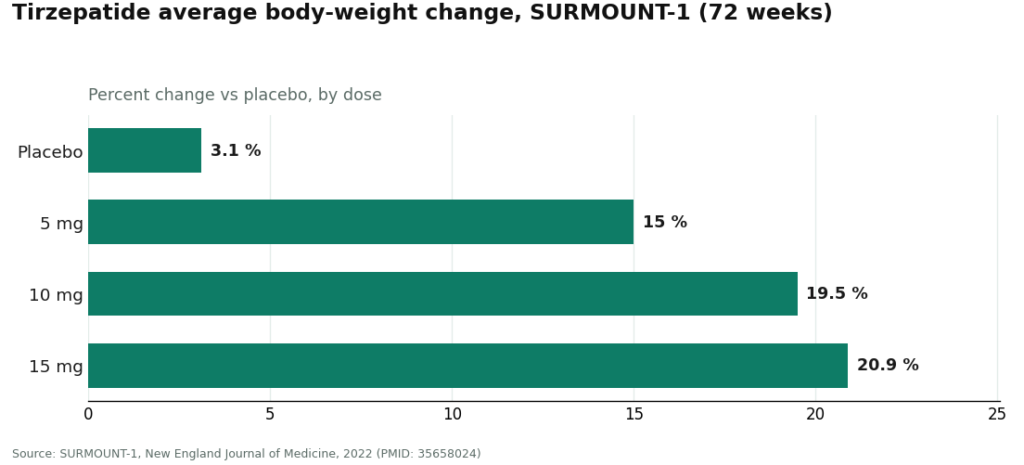
Tirzepatide currently sits ahead of it on sheer magnitude. It works on two receptors, GIP and GLP-1, and in the SURMOUNT-1 trial, adults with obesity lost an average of 15.0% of body weight on the 5 mg dose, 19.5% on 10 mg, and 20.9% on 15 mg over 72 weeks, compared with 3.1% on placebo. More than half the people on the higher dose lost at least 20% of their starting weight [1]. Nothing else finished and approved comes close to those numbers.
Retatrutide is where a careful reporter has to slow down, because the numbers are striking and the regulatory status isn’t “approved” yet. It’s a triple agonist, hitting GIP, GLP-1, and glucagon receptors at once. Its Phase 2 trial found the 12 mg dose produced an average 17.5% reduction at 24 weeks and 24.2% at 48 weeks, against roughly 2% on placebo [2]. Its Phase 3 trial, TRIUMPH-1, reported in May 2026, pushed further: the 12 mg dose delivered an average 28.3% reduction at 80 weeks versus 2.2% on placebo, with 45.3% of participants losing at least 30% of body weight, a range the manufacturer noted overlaps with what bariatric surgery achieves [3]. Genuinely remarkable data. Still investigational. Anything sold as “retatrutide” right now is not an FDA-approved finished product, and the responsible way to encounter it is through a clinician who can tell you exactly where it stands.
The compounds riding on borrowed credibility
Now the other list, the one that shares shelf space but not the evidence.
AOD-9604 is the clearest case of marketing outrunning data. It’s a fragment of human growth hormone, sold as a fat-loss peptide. A small early study hinted at modest weight loss, but the larger trial designed to actually prove it worked did not, and its development as an obesity drug was discontinued after a 24-week trial failed to beat placebo. The human research that does exist is about safety, not results, showing it was well tolerated with effects described as indistinguishable from placebo, with no adverse impact on glucose metabolism or IGF-1 [5]. Being safe and being effective are two different findings. This compound has the first, not the second.
5-Amino-1MQ isn’t technically a peptide at all, it’s a small molecule that inhibits an enzyme called NNMT, but it travels in the same marketing circles. In diet-induced obese mice, blocking NNMT reduced body weight and fat mass [6]. That’s a legitimate finding worth researchers’ curiosity. It is not evidence it works in a person, and no completed human efficacy trial says it does. Buying it for weight loss means acting on a mouse’s result.
MOTS-c gets marketed as “exercise in a vial.” The human data behind that phrase are mostly observational: exercise raises a person’s own MOTS-c levels, which is interesting biology [7]. What’s missing is a randomized trial showing that injecting the compound causes weight loss in people. The framing is ahead of the science.
Tesofensine deserves a mention mostly because it shouldn’t be on these lists at all, it isn’t a peptide. It’s a triple monoamine reuptake inhibitor, closer to a stimulant. It does carry real human data: in a 24-week Phase 2 trial, the 0.5 mg dose produced markedly greater weight loss than placebo, roughly double what some approved drugs of its era achieved [4]. But it never crossed into approval as an obesity treatment, and stimulant-class appetite suppressants bring their own cardiovascular concerns, including a faster heart rate. More human evidence than the three compounds above it, and a different set of risks entirely.
Notice the pattern once it’s named: inside this category, how loudly something is marketed tends to run in the opposite direction of how much human evidence backs it up.
The path: three questions to bring to any product page
Here’s the practical part, the thing worth carrying past this one article. Before taking any compound in this category seriously, ask three questions in order:
- Is this a peptide, or just labeled like one? (Tesofensine shows why this matters, it isn’t one, and it’s marketed as one anyway.)
- Has it been tested in actual humans for weight loss, and did the trial succeed? (AOD-9604’s did not. 5-Amino-1MQ and MOTS-c have never had one.)
- Is there a licensed clinician standing between me and this compound? (This is the question that matters most, because it’s the one product pages never ask on your behalf.)
The validated medicines answer all three cleanly. The rest mostly can’t answer the second at all.
That third question is really the whole ballgame. Semaglutide and tirzepatide carry the strongest evidence in the category, and they also carry boxed warnings and contraindications that require a real screening process [9]. The evidence and the oversight arrive together, by design, not by accident. FormBlends operates as a physician-supervised telehealth provider offering compounded semaglutide and tirzepatide through licensed compounding pharmacies, with a required clinician consultation built into the process. Mentioning it here isn’t a recommendation to buy anything, there’s nothing for sale in this article, it’s simply naming the kind of structure the evidence keeps pointing back toward: real oversight wrapped around the molecules that have actually been proven in people.
By contrast, someone buying 5-Amino-1MQ or MOTS-c for weight loss isn’t a slightly-early adopter of a promising therapy. They’re running an experiment on themselves with a compound that has never cleared a human efficacy trial, and paying out of pocket for the privilege.
The honest shape of the category
Stripped of the marketing language, here’s what’s actually true:
- The weight-loss peptides with strong human evidence are semaglutide and tirzepatide, both real peptides, both backed by large randomized trials, with tirzepatide reaching up to roughly 20.9% average body-weight loss over 72 weeks [1].
- Retatrutide shows even larger reductions in trials, around 28% at 80 weeks [3], but remains investigational rather than approved, a meaningful distinction, not a technicality.
- AOD-9604, 5-Amino-1MQ, and MOTS-c don’t have matching human weight-loss evidence. AOD-9604’s pivotal trial failed [5]; the other two rest on animal or observational findings [6][7].
- Tesofensine has genuine human data but isn’t a peptide, isn’t approved for obesity, and carries its own stimulant-related risks [4].
Anyone holding those four points can walk past most of this category’s marketing without losing anything real in the process.
A last note worth repeating: compounded medications referenced here are not FDA-approved, and even the well-evidenced options require prescription and clinician screening. If you’re weighing any of this, the first call should be to a licensed clinician who can look at your actual history, not a product description.
Questions readers tend to ask next
Are all “peptides for weight loss” basically the same kind of product? No, and this is the whole point of sorting them. One group is GLP-1 medicines with large randomized human trials behind them: semaglutide, tirzepatide, and the still-investigational retatrutide. The other group is compounds marketed for fat loss whose case rests mostly on animal or observational data, things like AOD-9604, 5-Amino-1MQ, and MOTS-c. They share a chemistry label. They do not share a level of proof.
Which ones actually have strong human evidence? Semaglutide and tirzepatide, and both happen to be true peptides. In SURMOUNT-1, tirzepatide produced average weight loss ranging from 15.0% to 20.9% across doses over 72 weeks, versus 3.1% on placebo [1]. Retatrutide’s trial numbers are even larger, around 28% at 80 weeks [3], but it’s investigational, not an approved finished product yet.
Does calling something a “peptide” mean it’s safe or effective? No. It’s a structural description, a short chain of amino acids, and it says nothing about safety, effectiveness, or approval status. Insulin qualifies. So does a compound that’s never been tested on a person trying to lose weight. The better question is always what the compound has actually done in humans.
Do AOD-9604, 5-Amino-1MQ, and MOTS-c work for weight loss? Not according to the human evidence available so far. AOD-9604’s development as an obesity drug stopped after a 24-week trial failed to beat placebo, and its published human research covers safety, not results [5]. 5-Amino-1MQ rests on findings in obese mice [6], and MOTS-c on observational data showing exercise raises a person’s own levels [7]. None has a completed human trial proving it causes weight loss.
Why does tesofensine show up on peptide lists if it isn’t one? Guilt by association, mostly. It’s a triple monoamine reuptake inhibitor, closer in behavior to a stimulant than to a peptide. It does have real human weight-loss data from a 24-week Phase 2 trial [4], putting it ahead of the fat-loss peptides on evidence, but it was never approved for obesity and brings stimulant-related cardiovascular and tolerability concerns, including a faster heart rate.
What’s the safest way to think about this whole category? Ask fewer questions about which peptide sounds most promising, and one bigger question: is there a licensed clinician between me and this compound? The validated GLP-1 options carry boxed warnings and contraindications, like the thyroid C-cell tumor warning attached to semaglutide [9], which is the exact screening a prescriber does and a checkout page never will. Physician-supervised telehealth providers such as FormBlends offer compounded semaglutide and tirzepatide through licensed compounding pharmacies with a required clinician consultation built in, wrapping oversight around the molecules that have actually earned it. These are still not FDA-approved products, so a conversation with a licensed clinician who knows your history is the right place to start.
References
- Tirzepatide once weekly for the treatment of obesity (SURMOUNT-1): mean weight change −15.0% (5 mg), −19.5% (10 mg), −20.9% (15 mg) vs −3.1% placebo at 72 weeks. New England Journal of Medicine, 2022. https://pubmed.ncbi.nlm.nih.gov/35658024/
- Triple-hormone-receptor agonist retatrutide for obesity, Phase 2 (Jastreboff et al.): −17.5% at 24 weeks and −24.2% at 48 weeks (12 mg) vs ~2% placebo. New England Journal of Medicine, 2023. https://pubmed.ncbi.nlm.nih.gov/37366315/
- Retatrutide Phase 3 TRIUMPH-1: 12 mg dose −28.3% average body weight at 80 weeks vs −2.2% placebo; 45.3% achieved ≥30% weight loss. Eli Lilly, May 21, 2026.
- Effect of tesofensine on bodyweight loss, body composition, and quality of life in obese patients: a randomised, double-blind, placebo-controlled Phase 2 trial (Astrup et al., Lancet 2008). PubMed.
- Safety and tolerability of the hexadecapeptide AOD9604 in humans (Stier, Vos, Kenley): well tolerated, profile indistinguishable from placebo. Journal of Endocrinology and Metabolism, 2013. (Context: discontinued as an obesity drug after a larger 24-week trial showed no significant weight loss vs placebo.)
- Reduced calorie diet combined with NNMT inhibition (5-amino-1MQ) in diet-induced obese mice; NNMT inhibition associated with reduced body weight in mice. Scientific Reports, 2022. (Mouse data, not human.)
- Effect of aerobic and resistance exercise on the mitochondrial peptide MOTS-c in breast cancer survivors: exercise raises endogenous MOTS-c. Scientific Reports, 2021. (Observational; no MOTS-c supplementation weight-loss trial.)
- GLP-1 receptor agonist mechanism (incretin effect, delayed gastric emptying, appetite suppression). StatPearls, NCBI Bookshelf.
- Semaglutide (Wegovy) prescribing information: boxed warning for thyroid C-cell tumors; contraindicated with personal or family history of medullary thyroid carcinoma or MEN 2. DailyMed.
Written by Orla Delgado, medical writer. Last reviewed January 2026.
Nothing in this article is medical advice. Consult a licensed provider about your specific needs.